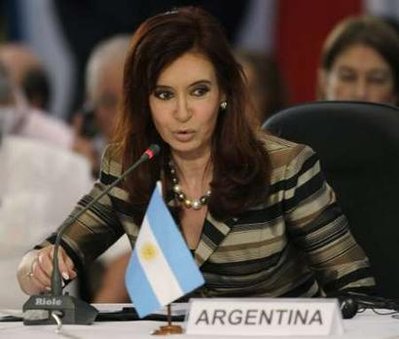
The newest move of Cristina Kirchner is the currency restrictions
which officially targets money-laundering. After the “corralito” in 2001 when
almost all bank accounts in Argentina got frozen and withdrawals from U.S.
dollar dominated accounts was forbidden. Argentinians do not trust their
banking system, bank vaults are common amongst the wealthier, they minimize the
use of credit cards and worst of all they avoid their currency. Argentinians
tend to keep all their savings in USD and all more expensive items such as cars
and houses are priced in USD.
If you talk about politics in Argentina you always have to
be careful who you are talking to and who is around you as it is a sensitive topic for them, just as football. Over the last 18 months I have spent over 1 year in Argentina, and I have been wondering a lot how did Cristina Kirchner manage
to get over 50% of the votes? I studied
at a small private university and discussed this topic with close to 100
Argentinians and only a small percentage of them seem to like her. Then how did
she get all those votes?

There are several reasons that have occurred to me but in
the end it all seems to be about trust, or distrust. Argentinians trust even
less in politicians than in the banks and it seems they are afraid of voting
for someone else as it could be worse than Cristina. Another reason is Cristina’s
policies regarding strikes and subsidies. She has gained popularity with the
middle and lower class by increasing subsidies for gas, water and public
transport. Regarding strikes she is a “liberalist” and protests are things that
you see every day.
The most common one is “corte de ruta”, which is when protestors
go into the middle of streets, roads or motorways and block all traffic. Laws
do not allow the police to arrest the protestors and therefore the protests can
go on forever. Currently I am stuck at the Argentina’s biggest airport Ezeiza
as the migrations staff is on strike and there are few thousand passengers
waiting in the check-in area. Hopefully this strike will just last for few
hours as the pressure is high. Over 20 lanes are supposed to leave in the
next 2 hours and passengers on arriving planes are not allowed to leave them.
Another thing I could never understand about Argentina is
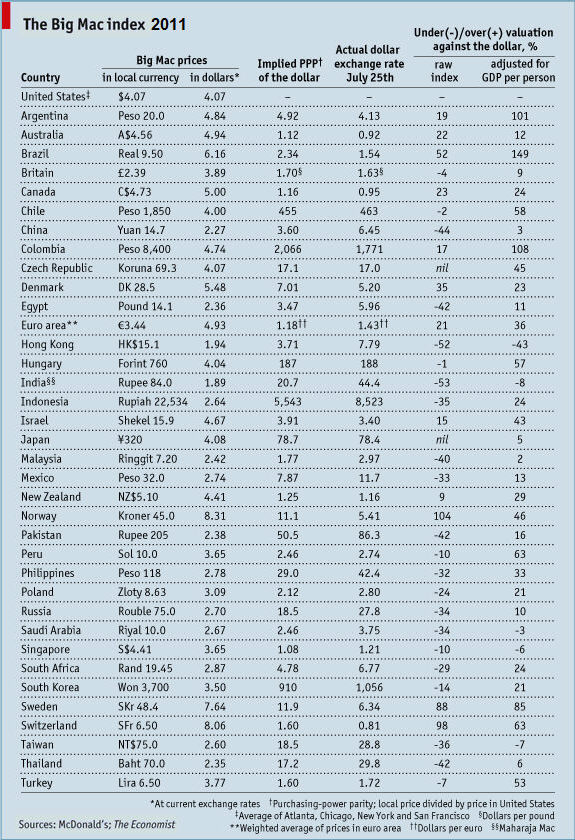
McDonalds. If you go to McDonalds in Argentina you never see any advertising
for Big Mac and it is only shown in small letters in a menu on the wall. The
reason for that is that the Big Mac is by far the cheapest product they offer
and they make less profit from it than other products. The rumour is that they
have been told by the government they need to keep the Big Mac price low for the
Big Mac Index (because otherwise they would have one of the most expensive
Big Macs in the world). The Big Mac meal today costs just over 20 (In the index its 20 pesos but current price is 22) pesos in
Argentina which is over 25% more than in London. I think that is bad enough
already, but there is no other product on the menu under 30 pesos! To make it
even worse we can look at the price of McFlurry; it costs 16 pesos in Argentina,
which is £2.40.
In Britain I cad get Big Mac (with fries and coke) for the same price,
and as a student I get McFlurry for free!! How fair is that???
If Argentina manages to resolve their political and economic
problems their future should be bright. Argentina covers a large area of over
2.5 million km2, which includes everything from glaciers to deserts.
They have access to huge amount of natural resources like gas and petroleum. Argentina has a big potential to improve their agriculture sector, currently 25% of their total exports come from soy-beans and by-products which they mostly sell to China where
it is processed further.
Sources:
Pictures: